
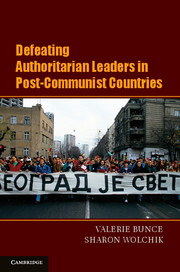
Defeating authoritarian leaders in postcommunist countries . Valerie Bunce and Sharon Wolchik.
Material type: TextSeries: Cambridge studies in contentious politicsPublication details: Cambridge : Cambridge University Press, 2011.Description: xi, 373 p. : ill. ; 24 cmISBN:
 - 9781107006850 (hardback)
- 9780521187251 (paperback)
- 324.9171/7 22
- JN96 .A58B876 2011
- POL000000
 General circulation books
| Item type | Current library | Collection | Call number | Copy number | Status | Barcode | |
|---|---|---|---|---|---|---|---|
|
General circulation books
|
Presbyterian University of East Africa - Main Library General Stacks | Non-fiction | JN96.A58 B876 2011 (Browse shelf(Opens below)) | 1 | Available | 2014-4195 | |
|
General circulation books
|
Presbyterian University of East Africa - Nairobi Library General Stacks | Non-fiction | JN96.A58 B876 2011 (Browse shelf(Opens below)) | 2 | Available | 2014-4238 |
Browsing Presbyterian University of East Africa - Main Library shelves, Shelving location: General Stacks, Collection: Non-fiction Close shelf browser (Hides shelf browser)
| JK1976 .W141 2017 The Art of winning elections; A gem of real of politics for effective leaders | JN 94 .A58P47 1999 European politics reconsidered / | JN94 .A69 E92 Bureaucrats and politicians in western democracies / | JN96.A58 B876 2011 Defeating authoritarian leaders in postcommunist countries . | JN 6695 .R46 2004 Politics in Russia. | JQ 281 .S73 2007 The state of India's democracy. | JQ 281 .S73 2007 The state of India's democracy. |
Includes bibliographical references and index.
Machine generated contents note: Part I. The Puzzle: 1. Breakthrough elections: mixed regimes, democracy assistance, and international diffusion; 2. Electoral stability and change in mixed regimes; Part II. Case Studies: 3. The 1998 election in Slovakia and the 2000 election in Croatia: model solidifies and is transferred; 4. Defeating a dictator at the polls and in the streets: the 2000 Yugoslav election; 5. Ukraine: the orange revolution; 6. Georgia and Kyrgyzstan: fraudulent parliamentary elections, mass protests, and presidential abdications; 7. Failed cases: Armenia, Azerbaijan and Belarus; Part III. Comparative Analyses: 8. Explaining divergent electoral outcomes: regime strength, international democracy assistance, and electoral dynamics; 9. The electoral model: evolution and elements; 10. The cross-national diffusion of democratizing elections; 11. After the elections: explaining divergent regime trajectories; 12. Conclusions: democratizing elections, international diffusion and U.S. democracy assistance.
"From 1998 to 2005, six elections took place in postcommunist Europe and Eurasia that had the surprising outcome of empowering the opposition and defeating authoritarian incumbents or their designated successors. Valerie J. Bunce and Sharon L. Wolchik compare these unexpected electoral breakthroughs with one another and with elections that had the more typical result of maintaining authoritarian rule. They draw three conclusions. First, the opposition was victorious because of the hard and creative work of a transnational network composed of local opposition and civil society groups, members of the international democracy assistance community, and graduates of successful electoral challenges to authoritarian rule in other countries. Second, the remarkable run of these upset elections reflected the ability of this network to diffuse an ensemble of innovative electoral strategies across state boundaries. Finally, elections can serve as a powerful mechanism for democratic change. This is especially the case when civil society is strong, the transfer of political power is through constitutional means, and opposition leaders win with small mandates"--
There are no comments on this title.